
Climate risk explained
27.02.2026

Climate-related financial risks are rapidly moving to the forefront of economic and policy discussions—and understanding where these risks truly lie is becoming essential for investors, companies, and public institutions. Building on their latest research (Region-Sector Heatmaps for Transition and Physical Risks), Eric Jondeau and Noé Notter shed new light on how transition risks and physical risks affect regions and sectors in fundamentally different ways.
In the Research Insights document—available in both English and French—E4S presents a clear, visual explanation of their methodology and findings, that reveal how climate risks concentrate across the global economy. This infographic accompany the full research paper and offer an accessible entry point into a complex topic. To deepen the discussion, we also conducted an in‑depth interview with Eric Jondeau, where he explains why they developed this framework, how they translate climate scenarios into financial metrics, and what their results mean for policymakers and investors. Together, the infographic and the interview provide a comprehensive and actionable perspective on climate risk—moving from abstract concepts to concrete analysis.
Read the Research Insights (EN and FR) and the paper
Discover the infographic
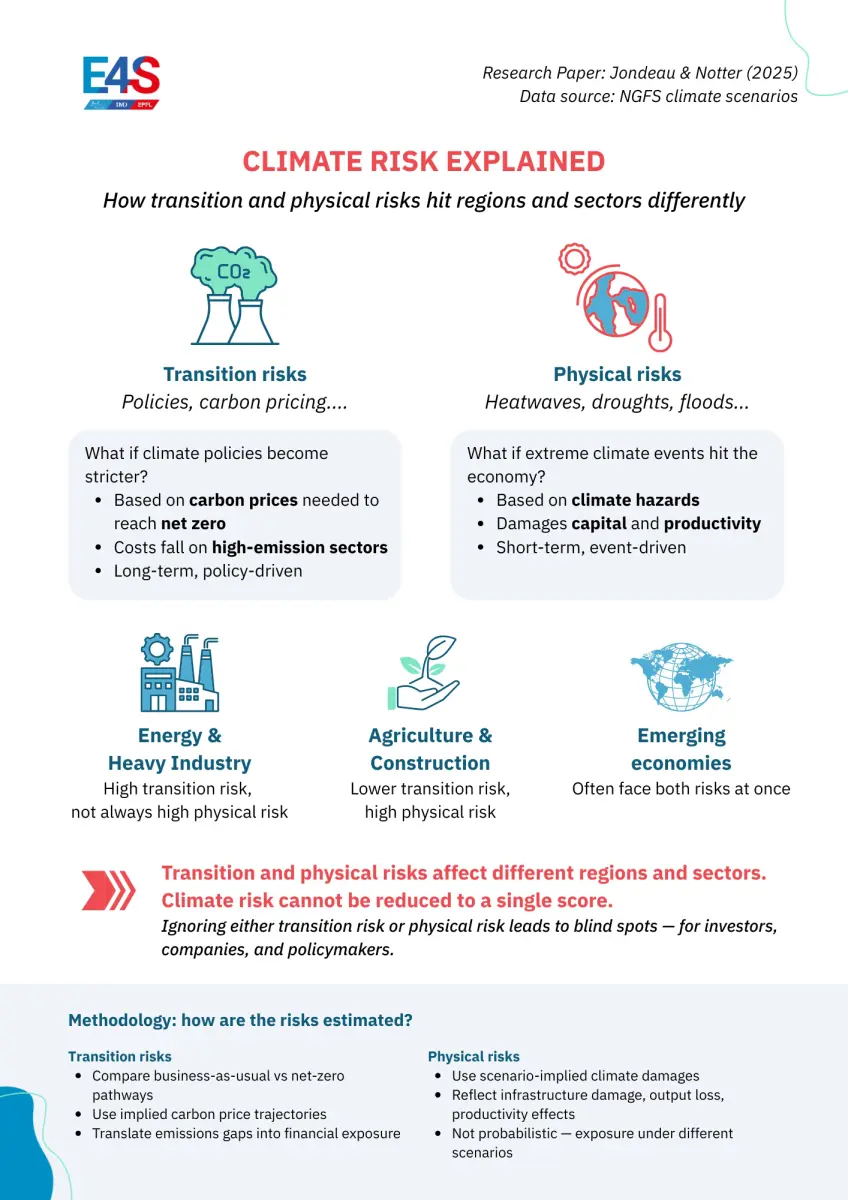
(click on the infographic to enlarge it)
Read the interview with Eric Jondeau
Why did you write this paper? What problem were you trying to solve?
There is a lot of discussion about climate risk in finance, but much less clarity about how big those risks actually are and where they are concentrated. Investors, regulators, and companies all know that climate change matters, but they often lack concrete, comparable numbers.
What we wanted to do in this paper was simple in spirit: take publicly available climate scenarios and translate them into financial costs, broken down by region and sector. Not abstract risks, but something you can actually compare across countries and industries.
You focus on two types of climate risk: transition risk and physical risk. What’s the difference?
Transition risk is about policy and regulation. It’s the risk that governments introduce stronger climate policies, especially carbon pricing, to move toward net zero. When that happens, some sectors suddenly face higher costs, lower profits, and lower valuations.
Physical risk is different. It’s about climate events themselves: heatwaves, droughts, floods, storms. These events can destroy capital, reduce productivity, and disrupt supply chains. That directly affects companies’ financial health.
The key point is that these two risks don’t hit the same places in the same way. A region might face relatively low transition risk but very high physical risk; or the opposite.
How do you actually measure transition risk in financial terms?
We rely on climate scenarios developed by the Network for Greening the Financial System (NGFS), which provide consistent pathways for emissions and carbon prices and we compare two scenarios.
First, a business-as-usual scenario, where emissions continue broadly along their current path. Second, a net-zero scenario, where policies are introduced to reduce emissions in line with climate targets.
The difference between these two trajectories tells us how much emissions need to be reduced: what we call the “gap.” Then we put a carbon price on that gap, using the price paths implied by climate scenarios. That gives us a monetary estimate of transition costs, sector by sector and region by region.
How do you measure physical risk in financial terms?
Physical risk refers to the economic consequences of extreme climate events such as heatwaves, droughts, floods, or storms.
In the paper, we rely on the climate damage projections embedded in NGFS scenarios. These scenarios describe how severe physical climate impacts could affect economic activity under different pathways. Rather than estimating probabilities of specific disasters, the NGFS assumes some physical disasters occurring at a specific time in a specific region.
In practical terms, the resulting damages reflect mechanisms such as destruction of infrastructure, losses in output, and reductions in labor productivity. We then assess how these economic impacts would translate into financial losses at the sector and regional level if such a scenario were to materialize over the considered time horizon.
Estimating climate risk sounds extremely difficult. What methodological approach did you choose?
Estimating climate-related financial risk is indeed extremely challenging. When discussing transition risk, one might try to assign probabilities to future regulatory changes — but doing so would be highly speculative.
Instead of attempting to forecast political decisions, we adopt a scenario-based approach. For transition risk, we measure the gap between emissions under a “business-as-usual” trajectory and emissions under a net-zero pathway. The implicit assumption is that climate policies would eventually force the economy to move toward the net-zero path, notably through carbon pricing.
We then assign a monetary value to this transition by multiplying the emissions gap by carbon price trajectories implied by climate scenarios. This allows us to quantify exposure without having to estimate the probability of specific regulatory events.
The same logic applies to physical risk. Rather than forecasting the probability of individual disasters, we evaluate the financial consequences implied by different climate scenarios. This provides a structured and comparable framework, even though uncertainty remains substantial.
Why do you use heatmaps?
Climate risk is extremely heterogeneous. The electricity sector does not face the same risks as agriculture. Europe does not face the same risks as India or Brazil.
Heatmaps allow us to show, very clearly, where the pressure points are. You immediately see which sectors are most exposed, which regions are lagging behind, and where risks are likely to materialize first.
What did the results reveal?
Two patterns stand out very clearly. First, transition risks are concentrated in a small number of emission-intensive sectors (electricity, steel, cement) but the regional patterns differ a lot depending on growth dynamics and energy mixes.
Second, physical risks show a very different map. Sectors like agriculture and construction, and certain regions that are more exposed to extreme climate events, show much higher vulnerability in this dimension.
This confirms that mechanisms underlying transition risk and physical risk are very different. Ignoring either one gives you a distorted picture.
What does this mean for investors or policymakers?
The main implication is that climate-related financial risks are not evenly distributed across sectors and regions, and that aggregated indicators can hide important sources of exposure.